


Ditto | What's New
What’s New
Component versioning

Library components are now versioned, so you can edit a component without instantly changing every project that uses it. Each instance stays connected to its component and only updates when you’re ready.
- Edit, then publish. Saved changes to a component are marked Modified until you publish them. Publish one component at a time, or select several from the Publish button in your library.
- Review and apply updates to instances. When a new version is published, its instances show that an update is available. Compare the current text with the latest version, then update the instance. You can also bulk-update stale instances.
- Need one-off copy? Detach an instance and save your edit as a regular text item.
Versioning is opt-in and only needs to be turned on once per workspace by an admin or editor. You can enable versioning in the component library. Turning it on gives your existing component instances unique Dev IDs.
Agent actions tracked in activity

Ditto's running activity log now tracks any edits or other actions taken by a teammate's AI agent. Keep track of changes and revert back to previous versions when needed.
September Product Updates
- Rich text support in the Public API —
PATCH/POSTon text items and components now accept bold, italic, underline, strikethrough, and line breaks via an HTML flag - New export formats: ARB file support, plus Android locale-directory output with configurable paths for mono-repo teams
- OAuth login for the CLI —
npx @dittowords/cli login, no more API keys to manage - Deep-linkable library components, built straight from public API data using Developer IDs
- Figma Dev Mode codegen for North Star projects (Android, iOS, and Ditto React SDK)
- One-click Developer ID regeneration
- Bulk multi-select linking for layers
- Tab-to-autofill in variant editors
- Real-time updates when projects are created or deleted
- CSV exports that reliably keep their
.csvextension - Shareable Figma tokens across a workspace
- Ditto Scan now requires a clean checkout of the default branch, to avoid false "changed" reports
- Email notifications once Ditto Scan has been completed
- Rich text support in the Public API —
Agent usage in style guide analytics
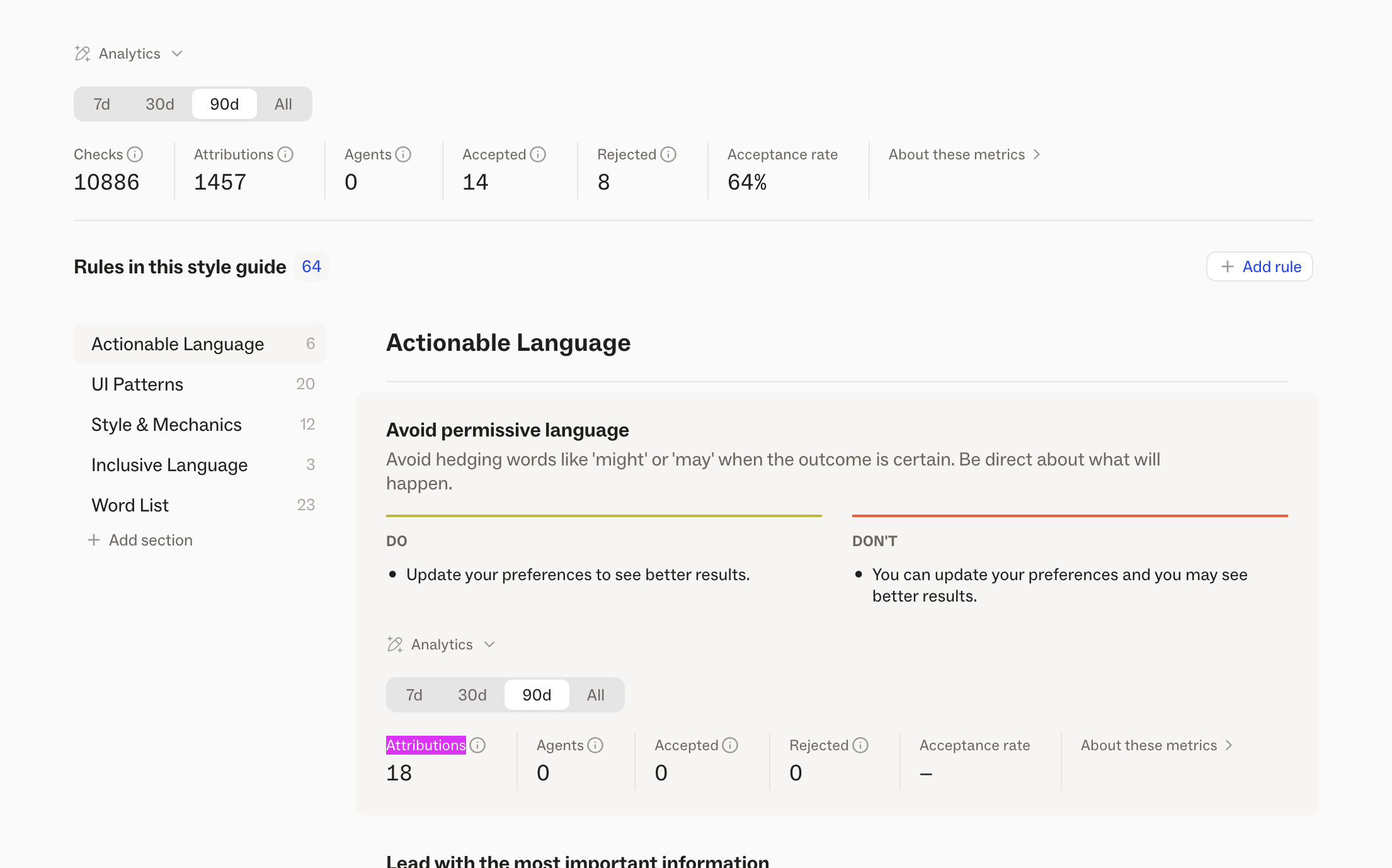
Style guide analytics now tracks agent usage alongside human usage — every time an agent pulls a rule through Ditto MCP to draft or check copy, it's counted right alongside your team's activity. And every metric you already had at the style guide level (checks, triggers, acceptance rate) is now tracked at the individual rule level too, so you can see exactly which rules are working and which ones need attention.
Live now in every Ditto workspace — log in to check it out.
Configurable AI settings

Choose which AI capabilities run in your Ditto Workspace. Magic Translate and Magic Draft now have their own workspace settings controls, so you can configure each AI capability independently.
Figma branching support

Branch a Figma file and keep every text item and component linked automatically. Variants, conflict reconciliation, and auto-linking all carry over into the branch.
SSO login

Use SSO to log into Ditto's MCP, API, and CLI. SAML-only teams can now authenticate agentic workflows without an API token.
Expanded MCP

We've massively expanded what you can do via the Ditto MCP, to make working alongside and inside Ditto even easier, from your AI tool of choice.
An agent connected to Ditto MCP can now:
- Create a new Ditto project
- Create, edit, and delete text items
- Create and edit your copy library
- Create, edit, and delete variants
- Search anything in your workspace — text value, language, dev ID, status, assignee, whatever you need
- Create, edit, and delete folders and text item blocks
- Run reviews and suggest edits on existing text
- Pull in existing style guide rules, or create, edit, and delete new ones
- List out all new notifications
No matter who — or who’s agent — takes one of those actions, it shows up in Ditto's running activity log. Every action tied a teammate, or a teammate’s agent.
Get started from Ditto’s developer documentation.
Agent package

Get every Ditto AI tool, out of the box. Setting up Ditto in every teammate's agent shouldn't take a checklist. That's why we built the Ditto Agent Package: one plugin installs all of Ditto's AI tools, configurable wherever you're working: Claude Code, Claude Desktop, or Cursor.
You get the Ditto MCP, always-on instructions so your agent checks against your standards in every session, and two built-in commands:
/ditto-reviewchecks your current diff's copy against your style guide/ditto-auditruns the same check across a whole directory
It's the same setup for every teammate, every time.
AI context for workspaces and projects
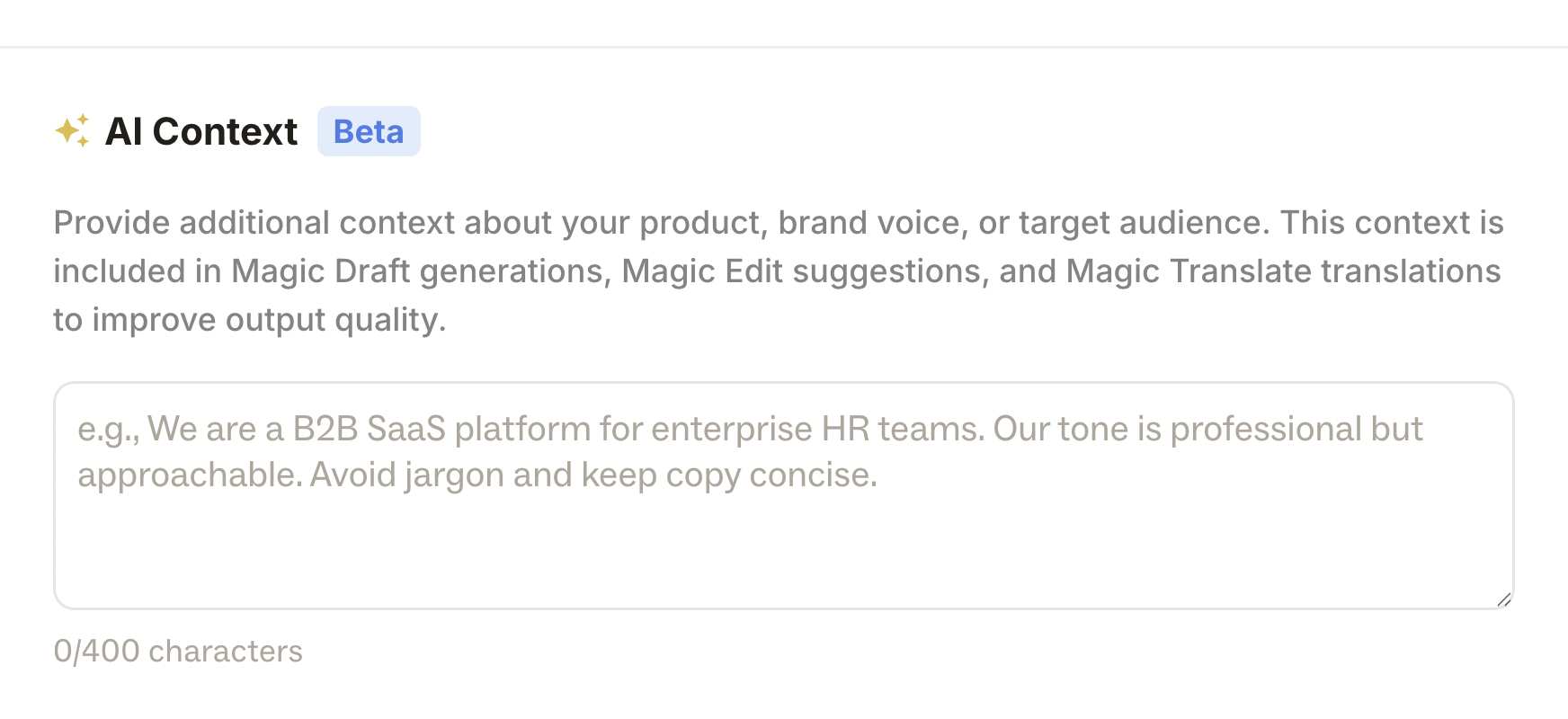
Add workspace & project context to improve Ditto's AI outputs: Magic Draft, Magic Edit, and Magic Translate. Adding this additional context means your Ditto AI tools can deliver even more precision, from the start.
Style guide rules take precedence over project context, which takes precedence over workspace context.
Define workspace-level context in workspace settings > AI menu. Add project-level context in the “AI context” modal of the project menu.
Translation quality scoring
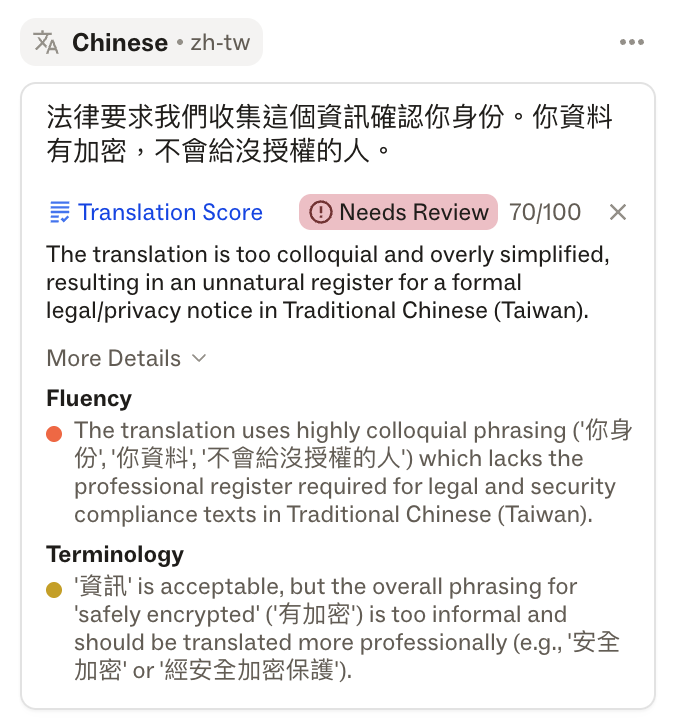
Use Ditto's Magic Translate to check the quality of your translated text items directly in Ditto. Catch issues earlier and streamline localization review, without leaving your workflow.
Translated text is evaluated on 5 different scales:
- accuracy
- fluency
- terminology
- locale conventions
- structural integrity
By evaluating each of these components, Ditto will provide a translation score, out of 100, for the copy in its specific context. If you've configured language-specific style guide rules, Ditto's AI score will take those rules into account, and treat them as the authority, when scoring the translation.
Slack integration
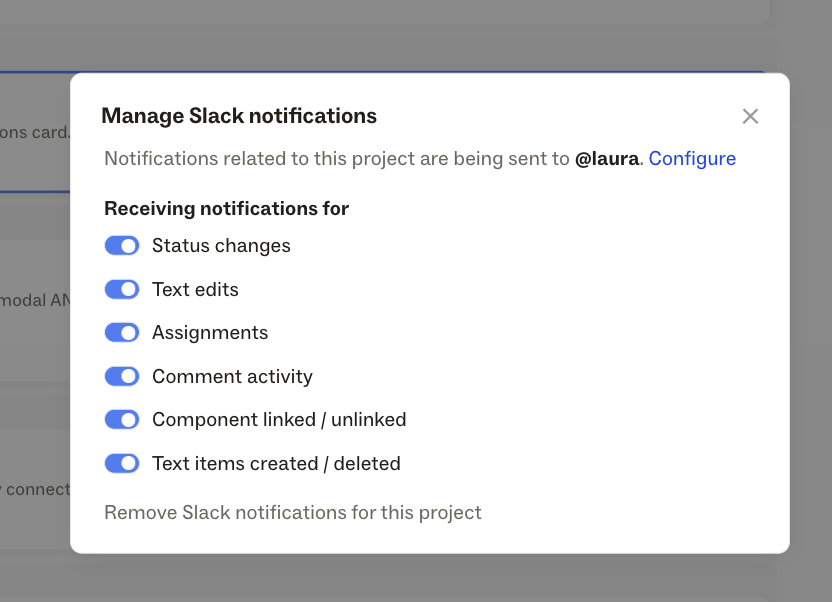
Send Ditto activity into your team's Slack workspace so you never miss an update.
Configure Slack notifications for edits within an individual project, or edits made to your Ditto Library. Get notifications for: Text edits, Status changes, Assignments, Comments, Linking, and Creating/Deleting.
Note: You'll need admin permissions to connect Ditto + Slack, but anyone with Editor access can turn on Slack notification for projects or for your Ditto Library.
June Product Releases
Export specific selection: You can now export the current selection from the web app with the same options as the full project export. This supports both text item selections and block selections.
Configure a
baseLocaleat the project and library level- In the existing
Variant & locale settingsconfiguration, in the top right menu of project and library pages, you can now set the base locale for project and library independently - You will see a new badge at the top of the project or library page, to indicate the
baseLocale - All AI translations and style guide rules will reference the
baseLocale
Search Improvements
- Search results are now always filtered by relevance, in projects and in your Ditto Library
- New sorting options for text items and library components (Manual, A–Z/Z–A, Created, Edited)
- Improved support for imperfect queries and symbols in search results
- In the existing
Ditto Scan

Ditto Scan is a new CLI command that scans your codebase, identifies your user-facing strings, and sets up your content system for you — automatically, based on what's already in production.
Run a new Ditto CLI command in your codebase. Continue setup in the Ditto web app. In moments, Ditto has extracted strings, metadata, translations, and content style standards based on what made it to production. You can review these extractions to assemble a working V1 of your content system: a component library, style guides, translation management, and the metadata infrastructure to keep it all connected.
Ditto Specs
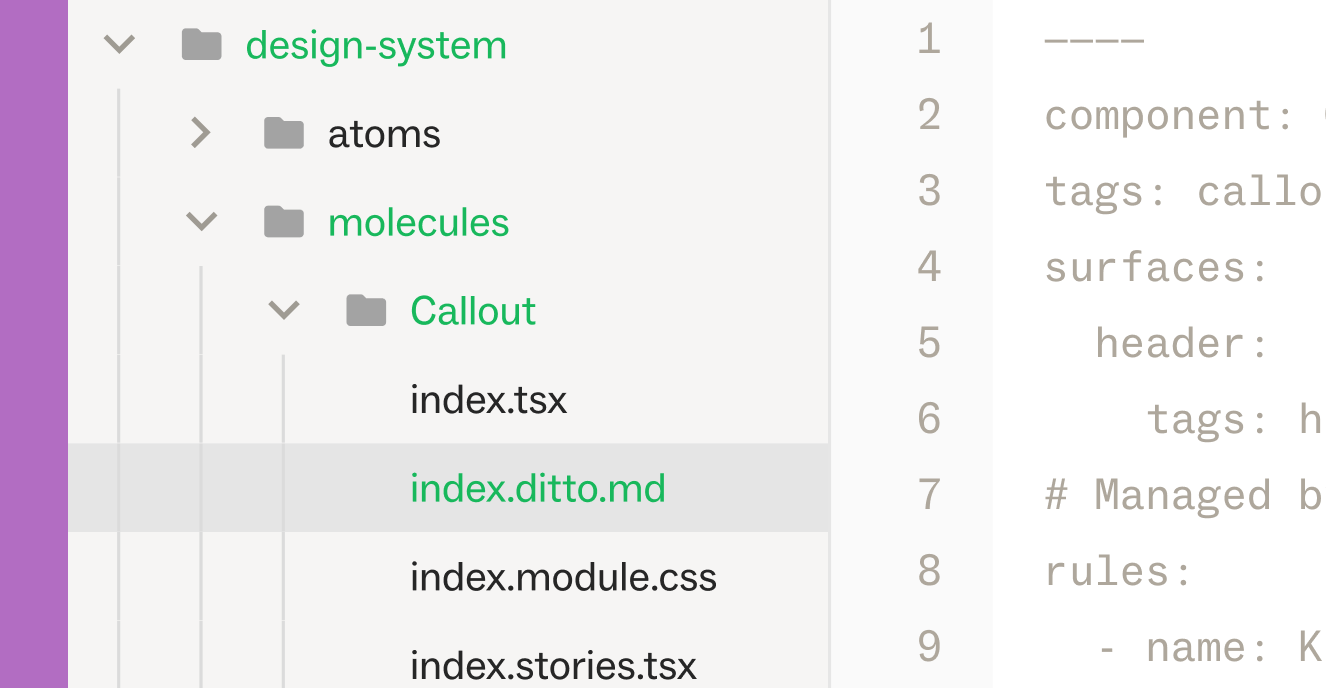
Ditto Specs are .ditto.md files that live in your codebase alongside your components. Each one declares the text surfaces a component renders — the specific pieces of user-facing copy like a headline, a button label, helper text, a tooltip — and carries the style guide rules that apply to those surfaces, synced from the Ditto platform.
Specs work at every level of your codebase.
- A
workspace.ditto.mdat the repo root sets the floor: universal voice, tone, and brand rules that apply everywhere. - Component-level specs layer on specifics. An agent working on a deeply nested UI component references the right rules for the specific surface it's touching.